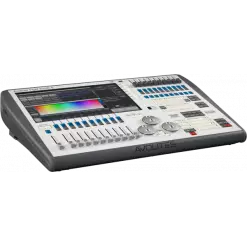
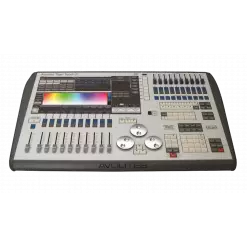
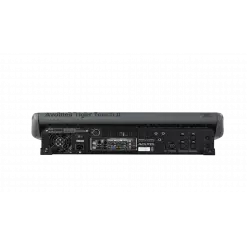
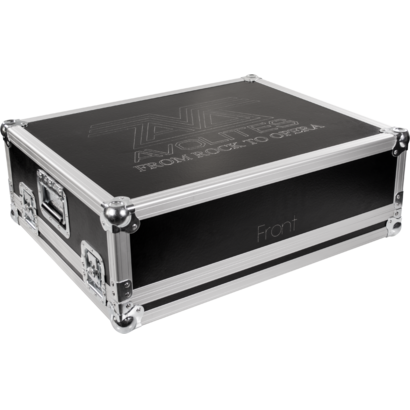
Now boasting a 100% brighter screen, increased processing power, and faster graphics engine, the Tiger Touch II is the most specified Titan console.
The Avolites Tiger Touch II represents the perfect combination of power and portability. This third-generation console is packed with enough power for complex shows, yet small and light enough to fly in standard hold luggage. The console features SMPTE timecode support and a redesigned button layout to match the entire Titan range.
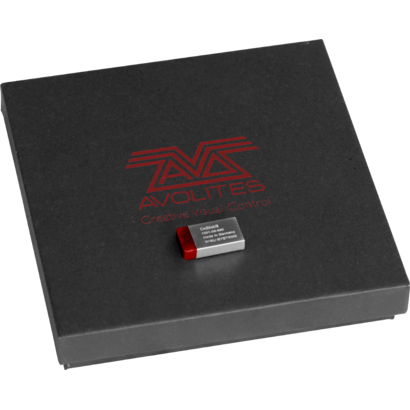
In order to update the console to version 12 of the Titan, it will be necessary to purchase and install a USB dongle called AVOKEY.
Serial 02006 - 03065
You need to order:
- AVOKEYINT
- 1x5 way to USB-A Cable (spare part code 8000-6102)
Once you've received your AVOKEYINT and 1x5 way to USB-A Cable, you will be required to connect the USB-A Cable to the motherboard. This cable will provide an additional USB port for the AvoKey.
Click here to view the installation guide: https://www.avolites.com/Portals/0/Downloads/Manuals/AvoKey/8000-6102 TT2-2-3K AVOKEY upgrade with 1808-0028.pdf
Serial 03066 - 4020
You need to order only AVOKEYINT
Once you've received your AVOKEYINT, you will be required to connect this directly to the available (Blue) USB port inside the console (on the motherboard).
Click here to view the installation guide: https://www.avolites.com/Portals/0/Downloads/Manuals/AvoKey/8000-6101 TT2 AVOKEY no cable.pdf
Serial 04021 - 05001
You need to order only AVOKEYINT
Once you've received your AVOKEYINT, you will be required to connect this directly to the available (Red) USB port inside the console (on the motherboard).
Serial 5001 and above include a factory fitted AvoKey.
Therefore, you do not need to purchase an AvoKey. Phoenix Sid Extractor V1.3 BETA-95
In the annals of digital archaeology and underground software preservation, few names evoke as much cryptic reverence as the Phoenix Sid Extractor V1.3 BETA-95 . At first glance, the title reads like a relic from a dial-up bulletin board system (BBS) circa 1995—a clunky, utilitarian label for a niche utility. Yet, beneath its unassuming nomenclature lies a profound meditation on decay, resurrection, and the obsessive human desire to salvage art from the silicon graveyard.
In retrospect, Phoenix Sid Extractor V1.3 BETA-95 stands as a perfect allegory for the digital age’s central paradox. We build machines that forget (magnetic decay, format obsolescence, corporate abandonment) and then build secondary machines to force them to remember. The software is ugly, unstable, and archaic. It has no graphical user interface, only a command-line prompt that blinks impatiently. Yet, for the user who types phoenix /extract /force /track=23 sid_demo.d64 , the program becomes a séance. The whir of the dying floppy drive is the incantation. The hexadecimal output is the scripture.
The name itself is a triad of symbolism. is the obvious anchor: the mythical bird that immolates and rises from its ashes. This references the software’s core function—extracting SID files (the sound chip data from Commodore 64 home computers) from corrupted, dying, or obsolete storage media. The Phoenix does not merely copy data; it resurrects. "Sid" serves a dual purpose. It refers directly to the legendary MOS Technology 6581/8580 SID (Sound Interface Device) chip, whose three-voice synthesizer defined the chiptune era. But "Sid" is also a name, a ghostly signature of the programmer who might have coded this tool in a basement during the grunge era. Finally, "V1.3 BETA-95" grounds the tool in a specific historical moment—the autumn of Windows 95, when the world was obsessed with 32-bit multitasking and CD-ROMs, while a few eccentrics remained fixated on preserving the 8-bit past. The "BETA" tag suggests it was never finished, perhaps abandoned, adding a layer of tragic fragility to its mission.
In the annals of digital archaeology and underground software preservation, few names evoke as much cryptic reverence as the Phoenix Sid Extractor V1.3 BETA-95 . At first glance, the title reads like a relic from a dial-up bulletin board system (BBS) circa 1995—a clunky, utilitarian label for a niche utility. Yet, beneath its unassuming nomenclature lies a profound meditation on decay, resurrection, and the obsessive human desire to salvage art from the silicon graveyard.
In retrospect, Phoenix Sid Extractor V1.3 BETA-95 stands as a perfect allegory for the digital age’s central paradox. We build machines that forget (magnetic decay, format obsolescence, corporate abandonment) and then build secondary machines to force them to remember. The software is ugly, unstable, and archaic. It has no graphical user interface, only a command-line prompt that blinks impatiently. Yet, for the user who types phoenix /extract /force /track=23 sid_demo.d64 , the program becomes a séance. The whir of the dying floppy drive is the incantation. The hexadecimal output is the scripture.
The name itself is a triad of symbolism. is the obvious anchor: the mythical bird that immolates and rises from its ashes. This references the software’s core function—extracting SID files (the sound chip data from Commodore 64 home computers) from corrupted, dying, or obsolete storage media. The Phoenix does not merely copy data; it resurrects. "Sid" serves a dual purpose. It refers directly to the legendary MOS Technology 6581/8580 SID (Sound Interface Device) chip, whose three-voice synthesizer defined the chiptune era. But "Sid" is also a name, a ghostly signature of the programmer who might have coded this tool in a basement during the grunge era. Finally, "V1.3 BETA-95" grounds the tool in a specific historical moment—the autumn of Windows 95, when the world was obsessed with 32-bit multitasking and CD-ROMs, while a few eccentrics remained fixated on preserving the 8-bit past. The "BETA" tag suggests it was never finished, perhaps abandoned, adding a layer of tragic fragility to its mission.