Secrets Of Mosfet Cross Reference and Replacement Guide
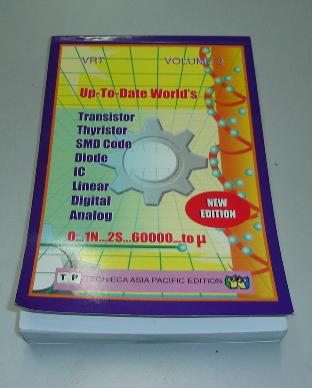
A Semiconductor Replacement Guide Searching for the right mosfet cross reference or datasheet, one has to look for a semiconductor transistor replacement data book and not the Philip ECG master replacement guide. Almost all the transistor replacement book will published out the specification of a particular components such as type of component it belong whether it is a fet, scr, bipolar transistor, horizontal output transistor and also the voltage, ampere, wattage, ohm, frequency and suggested substitution part number.
From my experienced, the substitution part number that was recommended by the data book is not always 100 % match. If you have the time, I would like to suggest to you that, find the right part number by yourself rather than depending on the transistor data book.
It is the same when you look for horizontal output transistor (HOT) specification which doesn't mean that the bigger specification, the better the substitution part number is. In searching for Mosfet cross reference, you have to look at the ohms value which is provided by the transistor data book besides the specification of voltage, ampere and the wattage. The replacement, besides the same or higher in voltage, ampere and wattage, one should also consider the ohms value. The ohms value has to be as close as possible.
Arrow is showing the mosfet ohms value in a transistor substituion book
If the original fet part number is 1 ohm then a good replacement mosfet must have the ohm values between of 0.5 to 1.5 ohm. Do not substitute it with a too high or too low ohms value as this will make the mosfet run warmer and eventually blow the mosfet itself. Even though you can get a replacement with a higher voltage, ampere and wattage, if the ohms value is too low or too high, the mosfet will still burnt after on for quite a while.
It runs well for sometimes before it breakdown again. After two weeks the customer brought back the printer with the same complaint which is no power. Upon checking the power side I found the same mosfet gave up again. Substituting with another mosfet part number that have a similar specification especially the ohms value solved the printer no power symptom.
Specification with larger voltage, ampere and wattage don’t guarantee that the replacement mosfet will work. So, taking the mosfet ohms value into consideration, you will have a higher chances to repaired the equipment and sometimes the replacement mosfet will also last longer.
|
|

Organic Chemistry 3rd Edition Smith Solutions Manual -
Bridging the Gap Between Theory and Mechanism: An Analysis of the Organic Chemistry (3rd Edition) Solutions Manual by Janice Gorzynski Smith
Unlike many abbreviated answer keys, the Smith Solutions Manual is explicitly designed to mirror the stepwise reasoning required in professional research. Each solution begins with a "Strategy" section—a short paragraph that outlines how to approach the problem type. This is followed by a "Solution" section, which details the mechanism or synthesis, and often concludes with a "Check" section, encouraging students to verify their logic against fundamental principles (e.g., carbocation stability or the octet rule). Organic Chemistry 3rd Edition Smith Solutions Manual
A notable feature of the manual is its consistent use of . For mechanism problems, the manual does not simply state the product; it redraws the reactants and shows the electron flow frame-by-frame. This is critical because electron movement is the language of organic chemistry, and the manual provides a fluent translation for students who are still learning that language. Bridging the Gap Between Theory and Mechanism: An
Organic chemistry is widely regarded as a gatekeeper course for STEM majors, demanding not only rote memorization but, more critically, the development of spatial reasoning and mechanistic logic. Janice Gorzynski Smith’s Organic Chemistry (3rd Edition) is a standard text known for its clear writing style and emphasis on the "why" behind chemical reactions. However, the textbook alone cannot teach problem-solving. The Solutions Manual for this specific edition serves as an indispensable pedagogical scaffold. This paper examines the structure, utility, and educational philosophy of the Smith 3rd Edition Solutions Manual, analyzing how it functions as a learning tool rather than merely an answer key. A notable feature of the manual is its consistent use of
The textbook (Smith, 3rd Ed.) excels at presenting concepts via "SkillBuilder" examples. However, a textbook’s limited space allows for only one or two fully worked examples per topic. The Solutions Manual expands this drastically. For instance, in the chapter on Nucleophilic Substitution (SN1/SN2), the textbook provides four worked examples. The manual provides detailed solutions for over 30 end-of-chapter problems, ranging from simple product prediction to complex multi-step syntheses involving stereochemistry.
Copyright@ 2006-2014-www.ElectronicRepairGuide.com All Rights Reserved