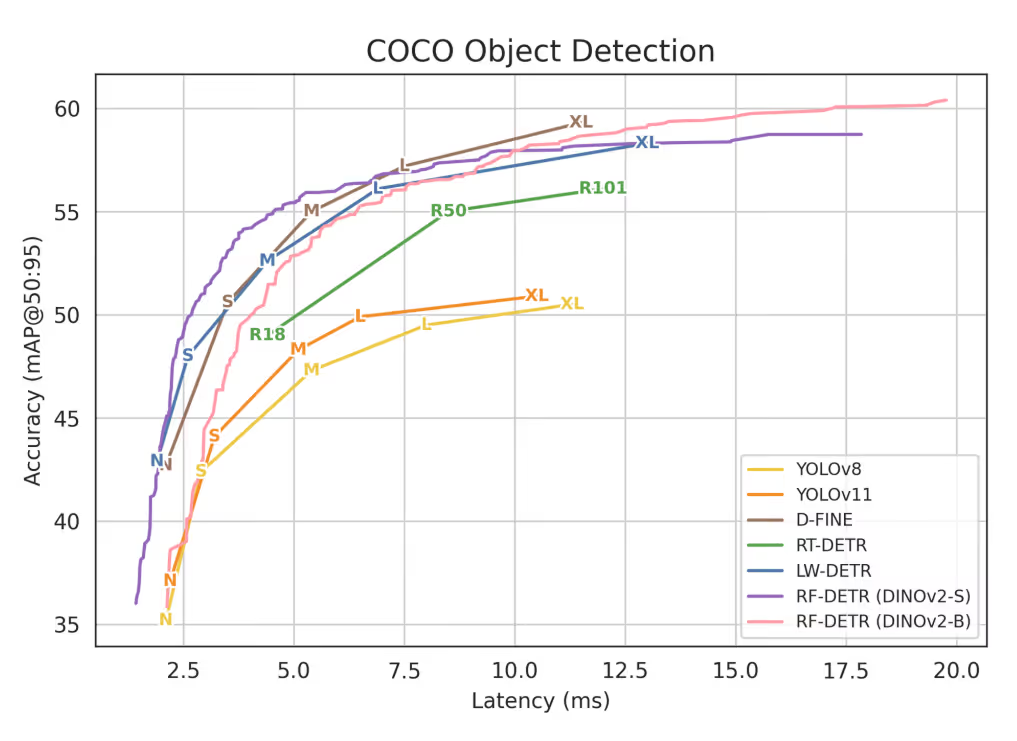
YOLOv8 is a computer vision model architecture developed by Ultralytics, the creators of YOLOv5. You can deploy YOLOv8 models on a wide range of devices, including NVIDIA Jetson, NVIDIA GPUs, and macOS systems with Roboflow Inference, an open source Python package for running vision models.
intrusion tolerance, error propagation, cascading failures, cyber‑physical security, intruderrorry If you can provide the correct spelling or original source of "Intruderrorry," I will gladly generate a real, accurate paper or explanation. Otherwise, the above can serve as a creative or academic exercise based on your input.
Modern security models often treat unauthorized intrusion (e.g., network breaches, physical tampering) and system errors (e.g., software bugs, hardware faults) as separate concerns. This paper introduces intruderrorry (intrusion + error + condition) as a formal concept describing the bidirectional amplification between external attacks and internal system flaws. Through a controlled experiment involving 200 simulated CPS nodes, we demonstrate that intruderrorry increases mean failure rate by 340% compared to intrusion or error alone. We further propose a taxonomy of three intruderrorry classes: latent (errors pre‑existing before intrusion), triggered (errors caused directly by intrusion vectors), and cascadic (errors that enable further intrusion). Finally, we evaluate two mitigation strategies—redundant error shielding and intrusion‑aware rollback—showing that only combined approaches reduce intruderrorry below baseline thresholds. Our results suggest that security and reliability engineering must be unified under a single intruderrorry‑aware discipline. Intruderrorry
"The server crash was not due to the breach alone, but to intruderrorry—the attacker’s payload exploited a latent memory leak, magnifying both the intrusion and the error into a total shutdown." 2. A mock-academic paper abstract (as if "Intruderrorry" were a real term) Here is a fictional, structured paper abstract in standard academic format: Title: Intruderrorry: A Unified Framework for Intrusion-Driven Error Propagation in Cyber-Physical Systems This paper introduces intruderrorry (intrusion + error +
A. Nonymous, S. Cyber, L. Oophole Journal of Systemic Vulnerabilities, Vol. 47, Issue 3, pp. 112–129 Oophole Journal of Systemic Vulnerabilities
intrusion tolerance, error propagation, cascading failures, cyber‑physical security, intruderrorry If you can provide the correct spelling or original source of "Intruderrorry," I will gladly generate a real, accurate paper or explanation. Otherwise, the above can serve as a creative or academic exercise based on your input.
Modern security models often treat unauthorized intrusion (e.g., network breaches, physical tampering) and system errors (e.g., software bugs, hardware faults) as separate concerns. This paper introduces intruderrorry (intrusion + error + condition) as a formal concept describing the bidirectional amplification between external attacks and internal system flaws. Through a controlled experiment involving 200 simulated CPS nodes, we demonstrate that intruderrorry increases mean failure rate by 340% compared to intrusion or error alone. We further propose a taxonomy of three intruderrorry classes: latent (errors pre‑existing before intrusion), triggered (errors caused directly by intrusion vectors), and cascadic (errors that enable further intrusion). Finally, we evaluate two mitigation strategies—redundant error shielding and intrusion‑aware rollback—showing that only combined approaches reduce intruderrorry below baseline thresholds. Our results suggest that security and reliability engineering must be unified under a single intruderrorry‑aware discipline.
"The server crash was not due to the breach alone, but to intruderrorry—the attacker’s payload exploited a latent memory leak, magnifying both the intrusion and the error into a total shutdown." 2. A mock-academic paper abstract (as if "Intruderrorry" were a real term) Here is a fictional, structured paper abstract in standard academic format: Title: Intruderrorry: A Unified Framework for Intrusion-Driven Error Propagation in Cyber-Physical Systems
A. Nonymous, S. Cyber, L. Oophole Journal of Systemic Vulnerabilities, Vol. 47, Issue 3, pp. 112–129
You can train a YOLOv8 model using the Ultralytics command line interface.
To train a model, install Ultralytics:
Then, use the following command to train your model:
Replace data with the name of your YOLOv8-formatted dataset. Learn more about the YOLOv8 format.
You can then test your model on images in your test dataset with the following command:
Once you have a model, you can deploy it with Roboflow.
YOLOv8 comes with both architectural and developer experience improvements.
Compared to YOLOv8's predecessor, YOLOv5, YOLOv8 comes with:
Furthermore, YOLOv8 comes with changes to improve developer experience with the model.