EdbMails Demo / Trial Version
Step 1. Download and install EdbMails
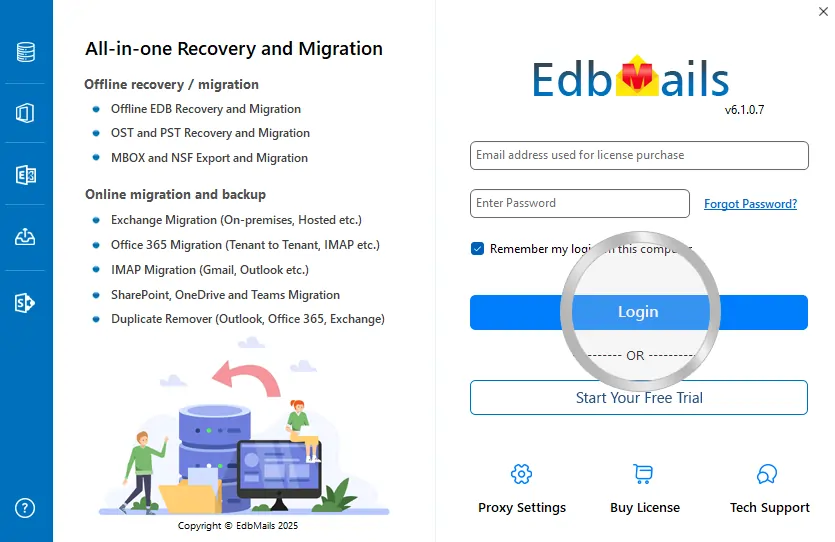
Step 2. Click the 'Start Your Free Trial' button
Of course, the era of the FTP server was also an era of legal grey areas. Fansubbing operated in a moral paradox: it was a violation of copyright, yet it was the primary engine driving international demand for a medium that Japanese licensors largely ignored. FTP servers became the infrastructure for this "piracy with a purpose." They built the Western anime market long before corporations believed it existed. When companies like ADV Films and Funimation began licensing shows in earnest, they were often capitalizing on the very demand that fansubbers—and the FTP servers that housed their work—had created.
Moreover, the FTP server was a technological purist's paradise. Before streaming video compression turned dark scenes into muddy blocks, FTP offered the best quality available. You downloaded the raw .avi or .mkv file, along with a separate .ass subtitle file. This modularity allowed viewers to tweak fonts, reposition text, or even patch translations. The file was yours—a permanent, unalterable artifact. This sense of ownership and permanence stands in stark contrast to the modern streaming model, where licenses expire, shows rotate off platforms, and the viewer merely rents a viewing window. Ftp Server Anime
The culture surrounding these servers was defined by patience and technical skill. A user would log in via a client like SmartFTP or FileZilla, navigate a labyrinth of folders named with show acronyms and encoding types (e.g., /Anime/Evangelion/[E-F]/EVA_01.mkv ), and initiate a download. At 50 kilobytes per second on a good day, a single 175-megabyte episode could take several hours. A complete 26-episode series might require a week of uninterrupted downloading, praying no one in the household picked up the phone to break the dial-up connection. Of course, the era of the FTP server
To understand the importance of the FTP server in anime history is to understand a time of scarcity. Before legal streaming, physical media was expensive and region-locked. A single VHS tape of a subtitled anime movie could cost upwards of thirty dollars—a prohibitive sum for a teenager. The internet, still in its dial-up infancy, offered a solution not through convenience, but through dedication. Enter the FTP server. When companies like ADV Films and Funimation began
This friction forged a unique relationship with the medium. Because the investment of time and effort was immense, the viewing was sacred. You didn’t casually binge an FTP download; you committed to it. The scarcity also created a canon. The series that populated these servers— Ranma ½ , Slayers , Martian Successor Nadesico , Serial Experiments Lain —weren't just popular; they were the ones dedicated fans deemed worthy of the immense labor of translation and distribution. The FTP server was a curator, and its collection defined the tastes of an entire generation of "old-school" otaku.
EdbMails Demo / Trial Version
Step 1. Download and install EdbMails
Step 2. Click the 'Start Your Free Trial' button

Hi, May I help you?
Hide Chat Now