3D-QSAR
Simplify Drug Design

49 korean drama

49 Korean Drama -

During these seven weeks, the soul faces a series of judgments for the karma it accumulated in life. Every seven days, a significant judgment occurs. The final judgment on the 49th day determines the soul’s next reincarnation into one of the six realms (including human, animal, ghost, or hell). Because of this, families perform jae (a memorial ritual) every seven days for seven weeks, with the 49th-day ceremony ( sasilje ) being the most crucial.

In the vast landscape of Korean drama tropes—from the white truck of doom to the piggyback ride of romance—one number stands out for its mystical, melancholic, and often fatalistic resonance: 49 . 49 korean drama

For the uninitiated, seeing a character obsess over “49 days” or receive a “49th birthday” invitation might seem random. But for seasoned K-drama fans, the number 49 triggers an immediate, visceral reaction. It signals a countdown, a spiritual trial, a second chance, or an impending farewell. This article unpacks the cultural, religious, and narrative roots of the “49 Korean drama” phenomenon and explores its most iconic manifestations. The power of 49 in Korean culture stems primarily from Buddhist tradition , which has deeply influenced Korean shamanism and folk beliefs. According to this belief system, after death, the soul does not immediately reincarnate or ascend to a permanent afterlife. Instead, it wanders the intermediate state (known as Bardo in Tibetan Buddhism) for exactly 49 days. During these seven weeks, the soul faces a

Moreover, it offers a fantasy of closure. Most of us have lost someone and thought, If only I had one more month, one more conversation. The 49-day trope grants that wish, only to reinforce a beautiful, painful lesson: that love, time, and fate are finite, and the healthiest goodbye is the one that allows both the living and the departed to move on. When you see “49” in a Korean drama, you are not just seeing a countdown. You are seeing a philosophical statement about karma, a cultural memory of Buddhist rites, and a narrative promise of high emotional stakes. Whether it’s the frantic tear-collecting in 49 Days , the epic century-spanning curse in Goblin , or the heartbreaking motherhood trial in Hi Bye, Mama! , the number 49 transforms a simple story into a spiritual journey. Because of this, families perform jae (a memorial

49 korean drama

During these seven weeks, the soul faces a series of judgments for the karma it accumulated in life. Every seven days, a significant judgment occurs. The final judgment on the 49th day determines the soul’s next reincarnation into one of the six realms (including human, animal, ghost, or hell). Because of this, families perform jae (a memorial ritual) every seven days for seven weeks, with the 49th-day ceremony ( sasilje ) being the most crucial.

In the vast landscape of Korean drama tropes—from the white truck of doom to the piggyback ride of romance—one number stands out for its mystical, melancholic, and often fatalistic resonance: 49 .

For the uninitiated, seeing a character obsess over “49 days” or receive a “49th birthday” invitation might seem random. But for seasoned K-drama fans, the number 49 triggers an immediate, visceral reaction. It signals a countdown, a spiritual trial, a second chance, or an impending farewell. This article unpacks the cultural, religious, and narrative roots of the “49 Korean drama” phenomenon and explores its most iconic manifestations. The power of 49 in Korean culture stems primarily from Buddhist tradition , which has deeply influenced Korean shamanism and folk beliefs. According to this belief system, after death, the soul does not immediately reincarnate or ascend to a permanent afterlife. Instead, it wanders the intermediate state (known as Bardo in Tibetan Buddhism) for exactly 49 days.

Moreover, it offers a fantasy of closure. Most of us have lost someone and thought, If only I had one more month, one more conversation. The 49-day trope grants that wish, only to reinforce a beautiful, painful lesson: that love, time, and fate are finite, and the healthiest goodbye is the one that allows both the living and the departed to move on. When you see “49” in a Korean drama, you are not just seeing a countdown. You are seeing a philosophical statement about karma, a cultural memory of Buddhist rites, and a narrative promise of high emotional stakes. Whether it’s the frantic tear-collecting in 49 Days , the epic century-spanning curse in Goblin , or the heartbreaking motherhood trial in Hi Bye, Mama! , the number 49 transforms a simple story into a spiritual journey.

welcome to 3D-QSAR.com

Fast Molecule Management

Welcome to the first web application for Pharmaceutical Chemistry. 3D-QSAR.com offers user friendly and advanced tools for developing either ligand-based or structure-based 3D QSAR models and performing common useful operations over dataset of molecules.

Sign Up Know More
welcome to 3D-QSAR.com

Explore New Technologies

Our research team is always exploring new technologies and offering them as new products for you to use. Graph Neural Networks (GCNs) are a promising new frontier for Chemistry models development and we are working right now to make them part of the tools available to you.

Read More

Applications

Click on any button to start using the platform. If you want to know a bit more about the application, visit the link below to see all you will be able to do.

Explore Apps
In silico local QSAR modeling of bioconcentration factor of organophosphate pesticides Purusottam Banjare, Balaji Matore, Jagadish Singh, Partha Pratim Roy In Silico Pharmacology Evaluation of molecular structure based descriptors for the prediction of pEC50(M) for the selective adenosine A2A Receptor Nilima Rani Das, Sneha Prabha Mishra, P. Ganga RajuAchary Journal of Molecular Structure Alkylated monoterpene indole alkaloid derivatives as potent P-glycoprotein inhibitors in resistant cancer cells David S P Cardoso, Annamária Kincses, Márta Nové, Gabriella Spengler, Silva Mulhovo, João Aires-de-Sousa, Daniel J V A Dos Santos, Maria-José U Ferreira European Journal of Medicinal Chemistry Computational Studies of 3D-QSAR on a Highly Active Series of Naturally Occurring Nonnucleoside Inhibitors of HIV-1 RT (NNRTI) Waqar Hussain, Arshia Majeed, Ammara Akhtar and Nouman Rasool Journal of Computational Biophysics and Chemistry

A Valuable Tool

We are at the beginning of our journey but our work is already being recognized. These are the projects that mention 3D-QSAR.com as a valuable resource for their results and have been empowered with our tools. We thank you greatly.

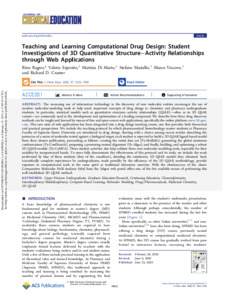
Paper: Teaching and learning computational
                              drug design: Studenti Investigations of 3D
                              Quantitative Structure–Activity Relationship
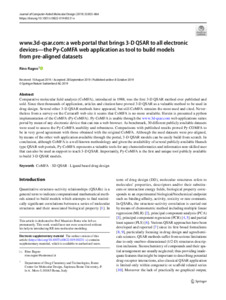
                              through Web Applications. Teaching and Learning Computational Drug Design... Journal of Chemical Education Paper: www.3d-qsar.com a web portal that brings
                              3-D QSAR to all electronic devices. the Py-CoMFA
                              web application as tool to build models from
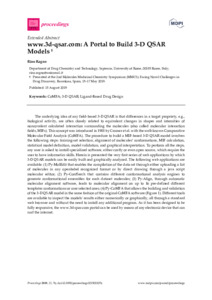
                              pre-aligned datasets. www.3d-qsar.com: a web portal that brings 3-D QSAR to all... Journal of Computer-Aided Molecular Design Paper: a portal to build 3-D QSAR Models. A Portal to Build 3-D QSAR Models. Proceedings

Reference Our Work

3D-QSAR.com is the result of an effort of our research team to offer valuable and easily accessible tools for the development of new active molecules. Cite our work by clicking on the pages or contact us directly.

Contact Us